
What is the labrum, and what does it do?
The labrum is a rim of soft tissue around the socket of the joint. The shoulder and the hip each have one, and it does a similar job in both: it makes the socket wider or deeper, which gives the joint mechanical stability. Because the labrum is soft tissue rather than bone, it can compress and move a little. It provides stability while still allowing motion, where a bony structure would be a hard stop. That is also why the labrum is prone to injury. It is sometimes the first thing to get injured.
What does a labral tear feel like?
When people have labral tears in the shoulder, many feel like the shoulder is dislocating. They say it feels like it's coming out of socket, and that is partially true. A torn labrum can subluxate, moving between the ball and the socket, and the ball can stop and go or snap over the socket. The shoulder can feel like it is locking, giving out or catching. These are mechanical symptoms.
People also come in with decreased range of motion, decreased power, and loss of motions they used to be able to do. Pain can make it hard to sleep, and some people wake at night and can't sleep on the affected shoulder. The physical exam and imaging findings help confirm the diagnosis.
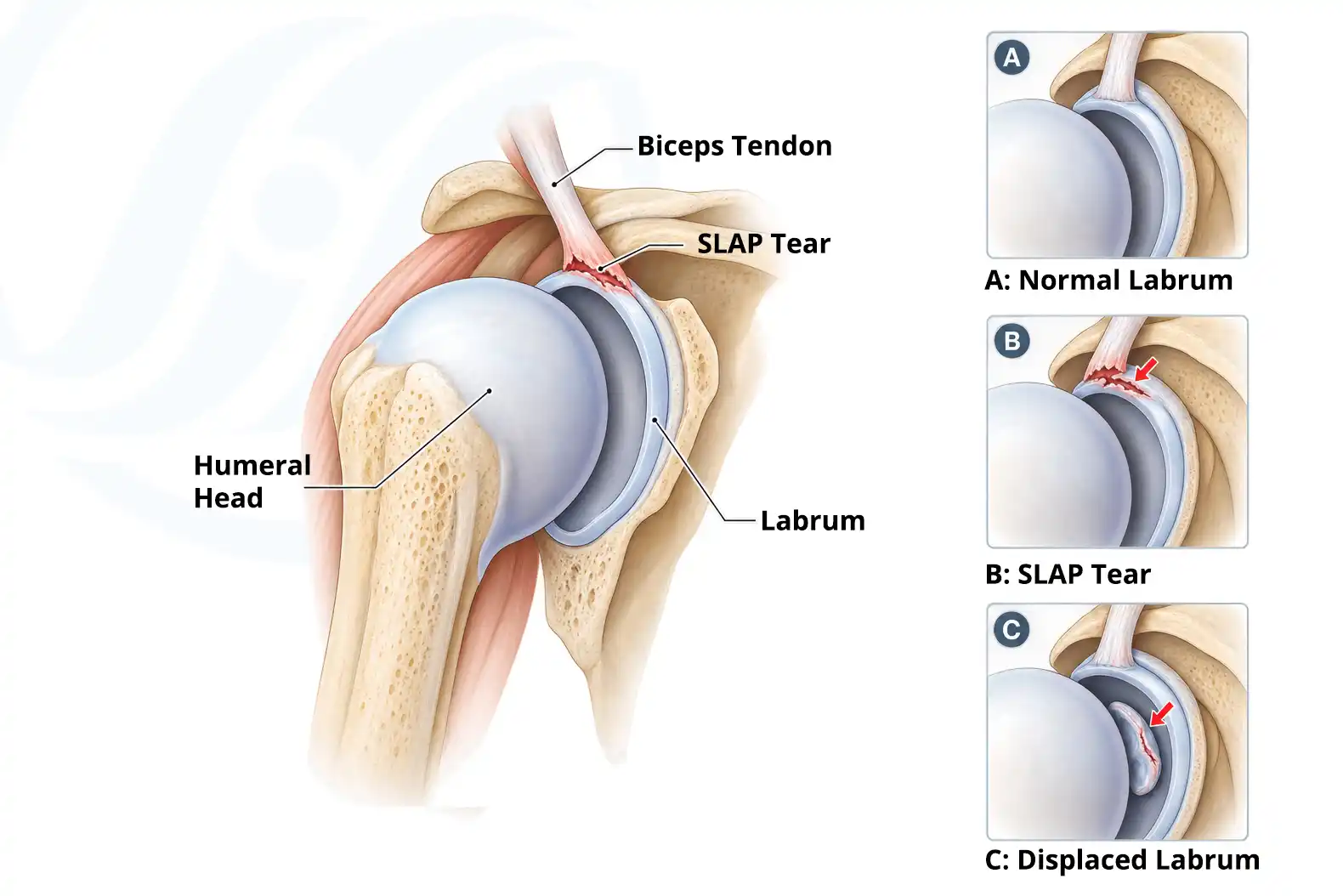
Normal and Torn Labrum
Why does a labral tear hurt?
It can be very painful because the labrum has nerve tissue. When it gets pinched between the bones, you can feel pain, discomfort and swelling in the joint.
In the shoulder, the biceps attaches to the labrum. When the labrum is injured, the biceps anchor can dislocate and subluxate into the joint. That anchor has nerve tissue too, so it is painful, and it can cause locking, catching, giving out and disability.
How does a labral tear happen?
There are two kinds. The first is caused by an injury. Motions of the shoulder that combine a high degree of external rotation with abduction, or a forced external rotation, can cause a shoulder dislocation, and that can tear the labrum. Putting the joint in a precarious position can do it too.
The second is more chronic and impingement-related. Dr. Jay says this is especially true in the hip, where bony shape (probably a genetic predisposition) or what you do for a living can lead to tears that happen gradually, without a single injury. He treats both kinds.
What is a SLAP tear?
SLAP stands for superior labral, anterior-posterior. Dr. Jay explains that unstable SLAP lesions are caused by the way the biceps long head inserts onto the labrum.
Can a labral tear heal on its own?
Dr. Jay says the body has a great potential to heal itself, and he has seen many injuries heal spontaneously. It depends on what caused the tear and what type it is. If the problem that caused the tear is still there, such as an activity, or anatomy and genetics (the shape of the socket can predispose a joint to labral tears), the tear is more likely to come back.
It also depends on how extensive the tear is. Sometimes the labrum has dislocated, changed shape, and is sitting between the ball and socket. Those tears are very hard to heal. Because the labrum has nerve-sensitive tissue, it is common to have lasting pain and disability in that situation.
Why did the labrum tear?
Dr. Jay looks at the cause: why did the tear happen? In the shoulder, the biceps is often the offender. The long head of the biceps runs through the bicipital groove, enters the joint and inserts on top of the labrum. If the labrum is repaired but the biceps keeps pulling on it, the injury can happen again. Without fixing the biceps and the labrum together, there is not likely to be long-lasting relief.
If the outlet of the shoulder is tight and causing impingement of the anterior supraspinatus and the biceps anchor, he also decompresses the outlet.
How is a labral tear treated?
When a labral tear is not healing, Dr. Jay offers to either debride it or fix it. He also looks for the condition that caused the tear, because if that problem is left alone, the tear can happen again.
Sometimes it takes two steps. He fixes the obvious, immediate problem, and also goes one step, or even two steps, behind it to fix what caused it. That repairs the tear and helps prevent it from happening again.
Why biceps tenodesis?
A biceps release on its own is effective for pain, and patients are usually happy, but it can leave the biceps weaker and cause a biceps deformity. Dr. Jay performs a tenodesis instead, so the biceps stays strong, there is no deformity, and the labrum problem is fixed.
Is treatment different for athletes?
In theory it could be. At HiSOI, Dr. Jay treats everyone as if they are young and athletic, with the best possible procedure for each person.
What is recovery like?
After a biceps or labrum repair, recovery is usually constant, consistent and gradual. Many patients report quite a bit of relief in the first couple of weeks. It is very common to hear patients say they are 40-50% better at two to three months, and 70-80% better at six months. People continue to improve for a year after surgery.